Tuesday, November 12, 2019

First Aquarium Fish Hunting

If you haven't purchased your fish aquarium fish yet, you're in for one of the best moments in the aquarium hobby. You can finally go and purchase the fish you have been dreaming of. However, where do you begin? What fish should you buy first? All these questions naturally come up pretty quick when sitting down to plan out your fish itinerary. I will answer all these questions for you to help you begin your aquarium fish hunting journey.

The first natural question that comes to mind is where do I begin? My suggestion to you is to find reliable resource, as well as perform your own independent research. You can find much success in the aquarium hobby by consulting with a local fish store owner, looking into online reef blogs, etc., but you also want to perform your own research to confirm your findings as well. The decision of which fish you will buy is meant to be long-term, so make sure you are comfortable with your choices. In your research, you also want to account for the matured size of each fish in comparison with the size of your aquarium to make sure you have enough space.

After gathering some information, you want to create a list of the fish you would like to put in your aquarium. You should identify the order in which you will introduce each fish. My biggest suggestion to you, no matter how hard it might be, is to not deviate from the list and purchase a different fish unless you have performed additional research. You want to make sure the fish you purchase will be a good substitute, and still compatible with the other livestock you carry in your aquarium.

The next step for you in this process is to actually complete the list of fish to purchase. This list is highly dependent on the owner of the aquarium, and should be created by you to make sure you enjoy what is in your aquarium. The suggestions I would provide when creating this list is to carefully consider the size of the fish, their temperament, reef compatibility (will they eat corals), and ideal aquarium size for their species. You want to make sure you purchase a fish that will grow to a size that is sustainable for your aquarium tank size. Ensure each fish you purchase will get along with the others in your aquarium ecosystem. Some fish species are not as compatible with others, and you want to make sure you identify this in your research. The order in which you introduce the fish can be very helpful if you are intending to purchase a highly territorial fish. Lastly, nothing is worse than purchasing a fish to realize they just ate through your entire new coral overnight. Make sure you purchase a fish that is reef-compatible, if you pursue a reef aquarium. Hopefully these tips will help you get off to a great start to your journey!

I hope these tips provided you a good starting point for helping you identify the fish to purchase.


Labels:

Monday, October 21, 2019

Even Cats Love Christmas

Image result for cats
Our 5-year-old cat, Yoshi, was diagnosed with renal failure. The veterinarian claimed that there isn’t much he can do. Yoshi will probably only live a few more years and from time to time he will need to be put in the hospital for treatment. My wife asked the doctor about a holistic veterinarian and if there are any in the area. As it turns out they allow a holistic veterinarian to use their facilities on Fridays. So we scheduled an appointment.
In about 5 weeks of work, which by the way includes acupuncture, our cat, Yoshi, is like a new person. (I know, I know but he is a little person to us.) He loves going to Dr. Fox and during the usual hour-long appointment he just lays there and purrs. She actually communicates with him. For all you Cartesian rationalists out there I know it sounds strange but Dr. Fox gives us information that she could not have known. Little intricate details that we did not know until we get home and check it out. FOr instance Yoshi tell her there was a chip out of his food bowl and it was bothering him. Sure enough when we got home there was a chip out of his bowl.
Regardless, she told us Yoshi really loves the Christmas season. I told her that my mom and dad really worked hard to make the Christmas season special for my sister, brother and me. Now, when I think of the season it brings a tear to my eye because even as my parents grew older they would allow me to give them a special Christmas at our house. I really miss them.
Dr. Fox also recalled how her parents would go all out for Christmas but her father was very disciplined and would require the tinsel to be put on the tree perfectly. She was not that good at it so he would not let her put it on the tree. Because of that her Christmas memories are not as fond as mine.
However, I do remember when Christmas changed dramatically in my life. My dad decided to modernize Christmas and went out and purchased an aluminum tree with one of those multi-colored wheels that spun around over a floodlight. I was devastated that we did not have a real tree for the first time in my life. There was some retribution though. There was a little setscrew that held the plastic colored wheel in place over the floodlight. Once in awhile it would back out and the plastic wheel would begin to wobble. One day it backed out and the wheel began to wobble and instead of telling my dad (we were not allowed to touch it) my sister, brother and me watch this wheel wobble down on top of the flood light and melt. We waited until it melted entirely over the light until we called him. Wow was he mad that day at modern technology.
So what is the point of all this? My wife and I have always had a real tree. I will admit to being a little obsessive so I was uncomfortable at times with the dirt a real tree can create. Two years ago the tree we bought started losing its needles quickly and we had to take it down two weeks before Christmas. I used this as an excuse to talk my wife into an artificial tree and actually had her convinced that it was a really nice tree. That is until this past Friday when Dr. Fox said Yoshi wants us to get a real tree again. Furthermore he exclaimed that I don’t want a spruce tree I want a pine tree like three years ago because it smells so good. The thought of the smell of pine brought back so many wonderful memories. As I basked in this joyous feeling I suddenly remembered the dreaded curse of many of us suffering through a mid life crisis, I am just like my parents. Well that isn’t all bad, just sometimes, and like my father, I get off track and forget what is really important.
As an ontological coach and more important a human, I often fall into the drift of life and forget to take a moment to be thankful and grateful for the world around me. I get so caught up in the details of life I forget to look up and see the big picture. On Sunday our Pastor said we should be thankful for the coincidences in life because they probably aren’t as coincidental as we may think. Perhaps it is the time to look up and truly celebrate what Christmas is really about.
Jesus loves the little children of the world and he calls us to love one and other as well. I am thankful for a little child (albeit not necessarily a human one) breaking my drift and getting me to look back up to the stars once again. We will have a real tree this year and more importantly I will pledge to make people and gratitude my priority for the season and hopefully the year to come. Life transitions can begin in many ways and sometimes we are awakened to our habits and transparencies in life by the smallest of incidents. In this case it was kind of like coughing up a little human hairball.
By the way, those of you who receive a Christmas card from us may find some teeth marks in it. Yoshi had Dr. Fox tell us he wants to sign the cards this year as well.
Have a Wonderful and Blessed Holiday Season!

Labels:

Saturday, October 5, 2019

How to Crate Train Your Puppy

Image result for Teach a Dog To Swim

One of the most difficult hurdles that any new puppy owner faces is housebreaking or as it is sometimes also referred to; potty training or doing business. Although there is no tactic that comes with a 100% guarantee, one of the most successful methods is crate training. Crate training can drastically reduce the amount of stress on the owner and the puppy that often comes with training the new four-legged member of your family.

So what is a crate? It is a cage that is usually made of plastic or wire. Wire ones are collapsible and the puppy has a great view of his surroundings. The plastic crates are lightweight and easy to clean and tend to be the most commonly used. Either can be purchased at a department or pet store. When purchasing a crate you must make sure there is enough room for the puppy to stretch right out and to stand erect. Make sure the crate is not too big though or all your potty training efforts in vain because the puppy will be able to do her business in one end and sleep in the other.

Crates can also be used for a variety of other things than just potty training. It provides the "den" security that can be traced back to their ancestors. It provides a place that is safe and cozy for the puppy. Putting the puppy in the crate when there is company or a lot of activity going on it saves her from all the reprimands from getting in the way. It is great for travelling. When you have to leave the puppy home putting her in her crate will save you from coming home to a disaster. It is also great for your puppy to sleep in through the night without the owner having to worry about her roaming around and possibly injuring herself. Puppies however, should NEVER be left alone in their crate for extended periods of time.

What makes the crate method of potty training so effective is because a puppy will not soil where it sleeps. However if you leave the puppy in the crate for too long it will have to do business and you will set your potty training efforts back to the beginning. The most important things you need to remember about crate training are consistency and routine and lots and lots of rewards. A crate is used differently to potty train then if you have to go out and you are leaving her home alone. When you are leaving your puppy home you have to put the crate in a small area, for example a bathroom and leave the crate door open with newspapers down for the puppy to do her business. Once the puppy is older and has good bladder and bowel control you can leave it in the crate but preferably not longer than 4 hours. However for potty training your puppy should stay in the crate then taken out frequently to the area that she is suppose to do her business. This can be either outside or on newspapers. For a very new puppy take her out to do her business every half-hour then after 8 weeks every hour. When the puppy goes potty where she is suppose to you can reward her with treats and lots of praise and maybe leave her out to play for awhile before putting her back in. If she does not go within around 10 minutes just put her back in her crate and try again later. If you keep a record of when your puppy goes, for instance how long after she eats or naps then you will know when to let her out and she can have more and more time left out to play. The crate will also help puppies learn bladder and bowel control.

A great idea is to either say something like "go potty" or "do your business" when you put her outside or on newspaper then when she hears those words she'll know it is time to go out. Also if you have something for her to scratch or ring or push she will learn as she gets older that that is what she needs to do to let you know that she needs to go out. Puppies want very much to please you so training them, as puppies will make things much easier for you and her as she gets older.

Of course when the puppy is initially introduced into the crate there will be lots of whining. This is not the sort of behavior you want to encourage or reward with attention. When she quiets down then you can take her out for a little playtime but the whining should be ignored. The crate should be kept in an area where she will not be alone and can be part of the family then at night take her into the bedroom with you. Be sure to have a soft blanket and a snuggle toy in the crate with her. I often put a blanket over the crate to give the puppy a very secure feeling. In the beginning you will have to get up a few times during the night to let her out but take a deep breath (or a nap) because this really will not last forever. I have seen puppies sleep through the night at 8 weeks.

Successful crate training requires commitment on the part of you the owner and it definitely is work. However, the reward in the end will make it more than worth the effort.

Labels:

Teach a Dog To Swim

Image result for Teach a Dog To Swim

You want your dog to swim?

We're going to try to give some advice on how to teach a dog how to swim and some general safety issues. As always check with your vet on any medical questions.

Teaching a dog to swim:

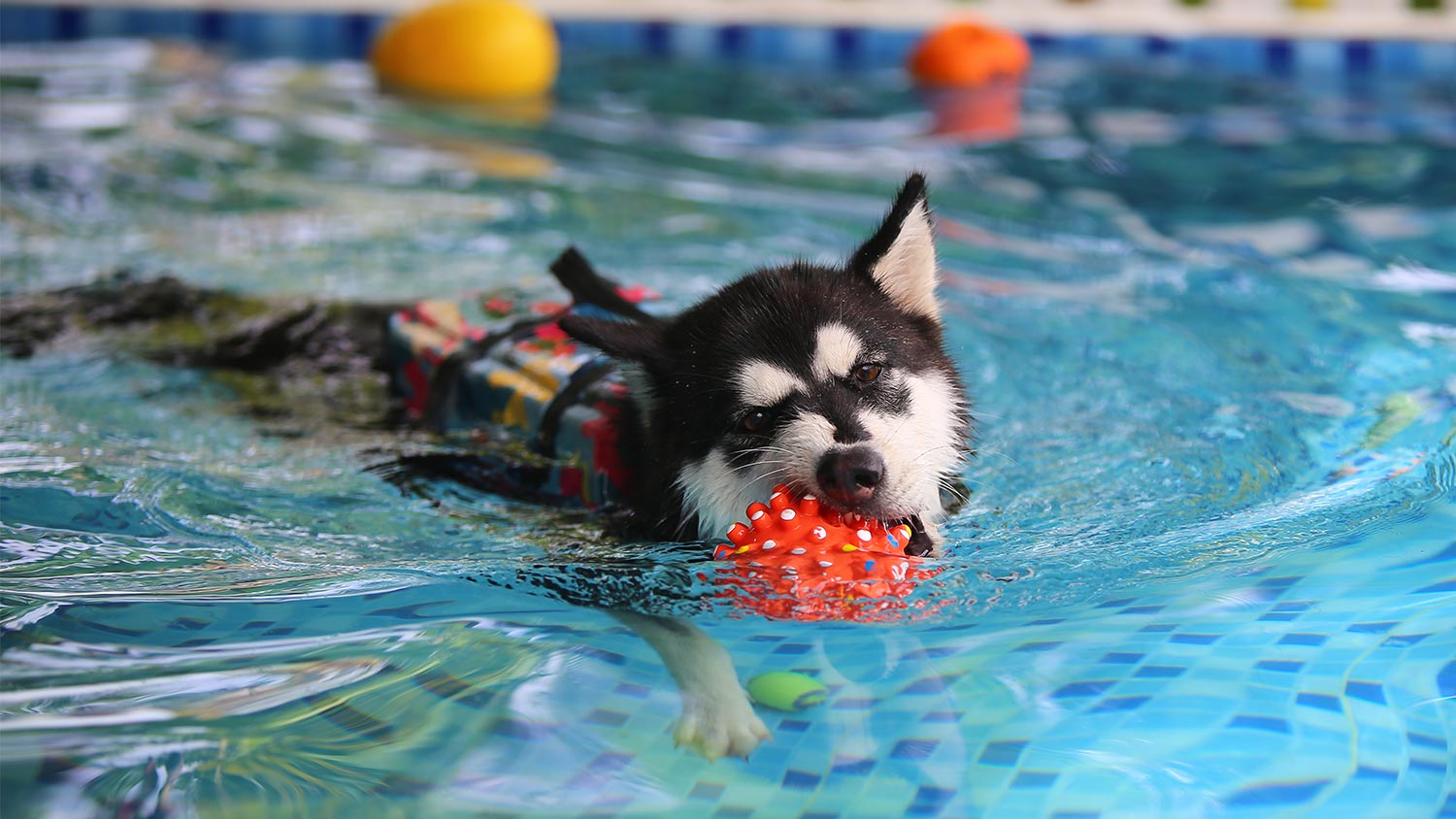
I would suggest starting your dog out in a pool or shallow lake where you can enter the water with your dog. Many dogs will be more confident if you are standing with them if they are nervous about venturing out on their own. So by walking out, you can build their confidence before letting them go on their own. Bring a favorite toy with you and encourage them out further by tossing the toy short distances and swimming over to it.

Some tips:

Bring another dog who knows how to swim along to help encourage your pet to try.

There are life vests (life jackets) you can purchase to aide in teaching your dog. These usually have handles that you can hold onto easily and are helpful for getting a dog back into a boat.

Water Freaking

Here is a common problem. Your pup goes off and won't come back. You have two choices, swim out and get them, or wait until they get tired and come back. Never let them off leash and away from you until you know for a fact they will return or start in shallow water where you can go get them should you need to.

I use a two toy approach to retrieving and swimming. I always keep one close by so I can toss it near me. Try to make a lot of noise to get their attention and toss it into the shallow water. Tennis balls are not the best choice as they can get lodged in the throat blocking the airway. I really like kong retrieving toys or retrieving bumpers.

Afterwords, make sure you RINSE your dog with fresh water to get out any bacteria or chemicals. You can also rinse your dog before hand to help the water not absorb into the coat hair.

Labels:

How to Play Safely With Your Westie Puppies

Image result for westie puppies

Just like children, westie puppies learn through play. Playing games with your west highland white terrier pups creates an opportunity to train them to obey your commands, gives them valuable exercise, and helps to build their strength, coordination, and agility. It is also fun for everyone.

Before you start playing games, there are some rules you should know, and safety precautions you should take. Your pups need to really run, not just walk on a leash, but be sure any area you play in has a fence. If they are city dogs, try finding a fenced-in tennis court for play. As a last resort, keep the puppy on an extra-long line. You do not want them to wander free until you are certain they will return on your command.

Never encourage your west highland pups to jump. The young bones are fragile, and not able to bear the stress of jumping until the growth plates are fused. Games like Frisbee, or serious agility training, are for older dogs, although there is still much you can do with your westie puppies by having them working at ground level. If you are eager to start these kinds of games, at about one year of age you can take your westies to their veterinarian for an x-ray, to see if the growth plates are completely fused.

Westie pups first learn to play in the litter by roughhousing with their littermates, but at six to eight weeks, the mother westie begins to discourage this behavior. You should discourage it as well, by never roughhousing in ways that allow them to bite, nip, or claw at your hands. A nip from a puppy may seem harmless, but if a full-grown westie nips, you have a behavior problem. It also teaches them that they can dominate you through aggression. If they do manage to get a nip in during play, discourage it in the same way dogs do, by imitating a 'yelp' sound.

Always remain in control with your pets. You want to teach them you are the 'alpha-dog.' Towards this end, never reward them by chasing after them when they run away from you. Instead, 'hide' from your pups, making them come after you. Tug of War games are good, but never allow the dogs to take the tug toy from you. You should be in control of it at all times, deciding when to end the game by taking it from the dog with a 'give' command. Never allow your west highland terrier puppies to grab a ball or other toy from your hands.

(Disclaimer: Any information contained in this site relating to various medical, health and fitness conditions of Westies or other animals and their treatments is for informational purposes only and is not meant to be a substitute for the advice provided by your own veterinarian. You should not use the information contained herein for diagnosing the health of any animal. You should always consult and check with your own vet or veterinarian.)

I do hope that you have found the article of use to you.

Good health and happiness

Labels:

My Dog Won't Stop Digging - What Can I Do?

Related image

Lonely, bored, tired of eating that same old stick, then maybe you would like to dig yourself a hole.
When it comes to the canine thought process this could be the reason why Scraps keeps tearing up your finely groomed lawn. This article will help you find the behavioral reasons why your dog digs and offers some suggestions on how to stop your companion's pesky habit.
First and foremost as an owner don't go placing blame on your good friend until you are sure it is their fault. A good way to find out if your dog has been digging is to check its paws and nose for soil or pica. This is a good indicator to see if they have been eating dirt. In this case consult a veterinarian because there are all kinds of nasty bacteria in dirt that can affect your dog's health. Another full proof method to find out if your animal is the culprit is to hold yourself a stake out and catch it in the act. Don't start correcting the problem until you are sure it is your animal causing the problem. Otherwise you might cause the dog more anxiety than it has already endured from watching some other animal dig up its master's lawn.
Once you have assessed that it is your dog doing the digging then you need to find out why it is digging. It is instinctual for dogs to dig for a number of reasons: boredom, loneliness, animals in the yard, to cool down, or just for fun. First you can judge by the nature of the whole and where it is located why your dog is digging. If your dog is digging next to the house or in shaded areas then it is probably too hot for it. If it continuously digs up the same spot in the yard then it is most likely a foreign animal and you should thank it for the early warning--gophers and moles can be a gardener's nightmare. If the placement of holes is sporadic then it is not receiving the stimuli or attention that a dog needs.
After you've come to a conclusion why your dog is digging then you can try some of these suggestions to help thwart its efforts. If it is an animal causing the problem then you should call an exterminator or animal control to handle the matter. Building a dog house or adding a pet door can give the animal the comfort level it needs while you are away. The more difficult digging scenario to mend is the digging out of boredom or digging for fun case. Do not, I repeat DO NOT, physically punish your dog as this will teach the animal nothing except disrespect for humans which can lead to biting and other misbehavior. If your dog is digging out of boredom try giving it a tasty alternative such as a rawhide bone. It is a common misconception that dogs bury their bones. More likely if they are digging for a bone it is because they can't remember where they left. So give them the treats where they can find them easily. If toys and chews don't work then try exercising your animal more often throughout the day. It could be that they aren't expending enough energy and need some kind of outlet. If these simple methods do not work then you might have to get creative. One method is to bury a piece of chain link fence where the dog has been digging--it will not like this rubbing against its paws. You can also bury a balloon or sneak up on it with a paper bag; the popping will work as shock therapy. Other suggested methods are burying the dog's feces, mousetraps, or moth balls to deter the animal.
In my own personal opinion the best way to keep the mischief down in an animal is to give them more love than they know what to do with. When you leave them alone they will more curious as to when you will return than with anything else.

Labels:

Putting A Dog To Sleep

Image result for Putting A Dog To Sleep

I was talking to a friend of mine today and I asked him how his kids (dogs) were. He lives on his own and the standing joke is - "does he want to do a swap with his dogs and my kids?"

He informed me very sadly that he had to get the older dog put to sleep. I knew the dog was quite old, but I knew from his expression and my own experience that it had been a hard decision.

He had stayed with the dog, stroking and talking to him as the vet administered the injection. I was surprised at my reaction, because it immediately brought back memories of my last dog being put to sleep. It surprised me that it still hurt after all this time.

I have found that non-dog owners think you are a bit barmy for reacting with a lot of emotion to a dog's death. They tend to forget that the dog ( or any other animal) was part of your family.

If dogs could talk what stories they could tell.

I remind you of a beautiful prayer called "A Dog's Prayer". It is by Beth Norman Harris. "Treat me kindly, my beloved master, for no heart in all the world is more grateful for kindness than the loving heart of me.

Do not break my spirit with a stick, for though I should lick yourhand between the blows, your patience and understanding will more quickly teach me the things you would have me do.

Speak to me often, for your voice is the world's sweetest music, as you must know by the fierce wagging of my tail when your footsteps falls upon my waiting ear.

When it is cold and wet, please take me inside, for I am now a domesticated animal, no longer used to bitter elements. And I ask no greater glory than the privilege of sitting at your feet beside the hearth.

Though had you no home, I would rather follow you through ice and snow than rest upon the softest pillow in the warmest home in all the land, for you are my god and I am your devoted worshiper."

(Disclaimer: Any information contained in this site relating to various medical, health and fitness conditions of Westies or other animals and their treatments is for informational purposes only and is not meant to be a substitute for the advice provided by your own veterinarian. You should not use the information contained herein for diagnosing the health of any animal. You should always consult and check with your own vet or veterinarian.)

Until next time, good health and best wishes.

Labels: